

Polyester quilt batting is the unsung hero for so many projects. It's tough, budget-friendly, and surprisingly versatile, giving quilts a beautiful puffiness and resilience that lasts. This makes it a fantastic choice for quilts that are meant to be used and loved—think everyday bedspreads, cozy kid's quilts, and all those wonderful charity projects.
Why Modern Quilters Trust Polyester Batting
Picture this: you've poured hours, maybe even weeks, into piecing a gorgeous quilt top. You finish it, wash it, and... it comes out lumpy, with the loft all but gone. It's a quilter's nightmare! This is precisely why quilt batting polyester has earned its place as a reliable workhorse for everyone from weekend hobbyists to professional longarm quilters. It just delivers a unique blend of performance and value that today's quilts need.
This batting is really the secret ingredient for quilts that are built for real life, not just for show. Unlike some of the more delicate natural fibers, polyester is engineered to be a survivor. It stands up to shrinking, resists bunching up in the wash, and won't mildew, meaning your hard work will look great through years of snuggling, spills, and spin cycles.
The Foundation of a Lasting Quilt
The real strength of polyester batting comes down to its synthetic fiber structure. These fibers have a natural "memory" that lets them bounce right back to their original shape. For your quilt, that means it keeps its fluffy loft and smooth, even appearance, even after being folded, sat on, or washed repeatedly. If you're making a quilt for a child's bed or a throw for the family couch, that kind of resilience is everything.
You can see its reliability reflected in its growing popularity. The global quilt batting market was valued at around $3.03 billion and is expected to keep on growing. It's a testament to how many quilters depend on it. For more on industry trends, you can check out insights from Verified Market Research.
The real magic of polyester is its predictability. You know it will wash well, hold its shape, and highlight your quilting stitches beautifully, project after project. It removes the guesswork, letting you focus on your creative vision.
In this guide, we're going to break down everything you need to know to make polyester batting work for you. We'll cover choosing the right loft, mastering quilting techniques, and more. By the end, you'll see why this versatile batting is the perfect go-to for quilts that need to be both beautiful and built to last. For a closer look at the technical details, dive into our guide on polyester fiber batting.
Understanding Loft, Drape, and Performance
When you're trying to figure out why so many quilters swear by polyester batting, it really comes down to three things: loft, drape, and performance. The most important one to get your head around is loft. Think of it simply as the batting's fluffiness or thickness. It's the single biggest factor that will shape how your finished quilt looks and feels.
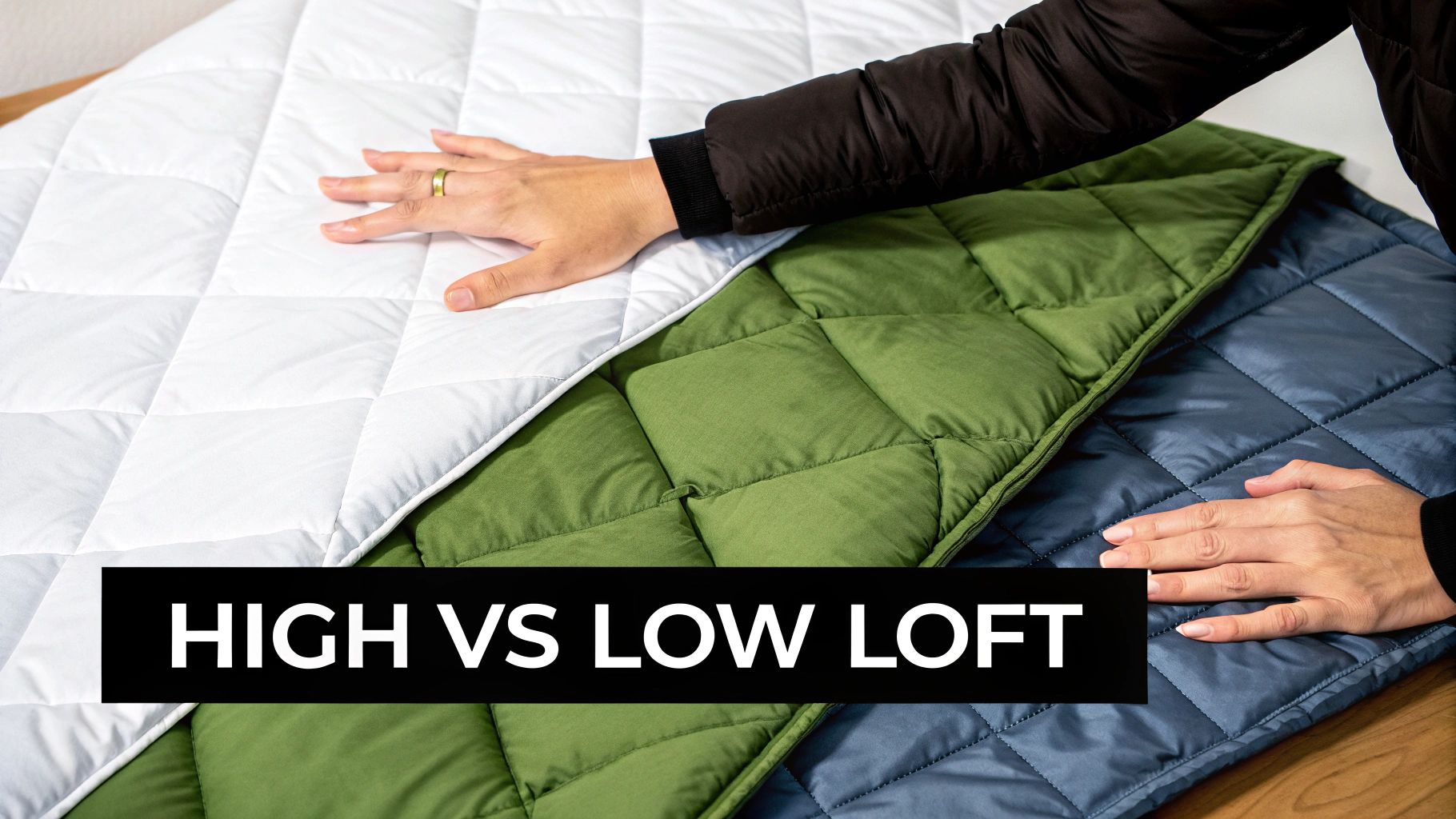
A high-loft batting is thick, airy, and puffy. This extra volume is exactly what you want when you need your stitching to really stand out, creating deep, dramatic shadows around each stitch line. It’s the go-to for tied quilts and cozy comforters where that plush, cloud-like feel is the whole point.
On the flip side, a low-loft batting is thin and much more dense. This gives your quilt a flatter, more modern profile with a wonderfully soft, flexible drape. It's the perfect partner for detailed machine quilting, as it lets your intricate piecing take center stage and allows the quilt to hang or lay perfectly flat.
The Secret to Polyester's Resilience
What really makes quilt batting polyester a standout is its incredible fiber memory. Picture stretching a rubber band and watching it snap right back to its original shape. Polyester fibers do pretty much the same thing. This gives the batting a built-in resilience that fights against bunching up, shifting around, or going flat over the years. That springiness is engineered right into the material.
What does that mean for your quilt? It means that even after being squished in a closet or going through the wash for the tenth time, it will bounce back, keeping its original loft and smooth finish. It's a true workhorse, built for real life. This makes it a fantastic choice for kids' quilts, couch throws, and any everyday quilt that needs to handle a little wear and tear.
At its core, polyester batting offers unmatched reliability. Its engineered fibers provide consistent loft, excellent stitch definition, and long-term durability, ensuring your quilt looks just as beautiful after its 50th wash as it did after its first.
The quilting world has certainly taken notice. Polyester batting is the fastest-growing part of the industry, and it's projected to grow at an impressive 9.2% CAGR. This boom is driven by its affordability, amazing durability, and natural resistance to mold and mildew—all things modern quilters are looking for.
How Loft Shapes Your Quilting Choices
The loft you pick will directly impact your quilting technique and the final texture of your quilt. It's a simple rule: the thicker the batting, the more it will puff up around your stitches, making them more visible.
To help you visualize which loft is right for your next project, here’s a quick guide.
Polyester Batting Loft and Recommended Uses
| Loft Type | Thickness | Best For | Quilting Distance |
|---|---|---|---|
| Low Loft | 1/8 to 1/4 inch | Machine quilting, wall hangings, table runners, garments | Up to 4 inches apart |
| Medium Loft | 3/8 to 1/2 inch | Hand quilting, light comforters, longarm quilting | 2 to 4 inches apart |
| High Loft | 1/2 to 1 inch | Tied quilts, comforters, trapunto, upholstery | Up to 5 inches apart |
Ultimately, picking the right loft isn't about a right or wrong answer. It's all about matching the batting to your creative vision and the quilt's final purpose.
To dive deeper into how different batting types stack up against each other, our handy quilt batting comparison chart is a great resource. Getting to know your materials is the first step toward confidently creating your next masterpiece.
Polyester vs. Cotton vs. Blends: Which One is Right for Your Quilt?
Walking down the batting aisle can feel overwhelming. Polyester, cotton, blends… where do you even start? Let’s ditch the technical jargon and think about this like an experienced quilter would. The best way to choose is to ask a simple question: What is this quilt’s destiny?
Think about a classic, heirloom-style baby quilt. You want it to be soft, breathable, and get that gorgeous, crinkly texture that only gets better with every wash. That’s a job for 100% cotton batting. It gives you that beloved, lived-in feel and the traditional puckered look that so many of us fall in love with.
Now, let's flip the script. Imagine you’re making a modern, graphic quilt for a college dorm room. This quilt is going to see some action—it needs to stand up to being tossed on the floor, frequent trips to the laundry, and maybe even a pillow fight or two. For that kind of heavy-duty job, the incredible resilience of quilt batting polyester is your best bet. It refuses to shrink, holds its shape beautifully, and keeps its loft through thick and thin.
The Best of Both Worlds: Blended Batting
So, what if you don’t want to choose? What if you want the softness of cotton and the durability of polyester? Say hello to blended batting, the superstar of the quilting world. The most common is the 80/20 cotton-poly blend, and it’s a quilter's favorite for a very good reason.
This workhorse batting gives you the best of both worlds. You get the natural, gentle feel of cotton paired with the strength, loft, and stability of polyester. It creates a subtle crinkle after washing—not as much as pure cotton—while offering far more durability. It's the perfect all-rounder for everything from cozy couch throws to large quilts you plan to send to a longarmer.
Choosing a batting isn’t about finding the “best” one, but the “right” one for your project. When you match the batting’s personality to the quilt’s purpose, you’re setting yourself up for success.
A lot of quilters still have a picture of old-school polyester in their minds—stiff, hot, and plastic-y. But let me tell you, things have changed! Modern manufacturing has completely transformed polyester batting. Today’s versions are incredibly soft and breathable, offering fantastic comfort alongside their legendary durability.
Want to go even deeper? You can explore a more detailed breakdown in our guide on cotton vs polyester batting in our comprehensive guide.
A Head-to-Head Comparison
To make the choice even clearer, let's put these fibers side-by-side and look at what really matters for your finished quilt.
- Durability & Loft: Polyester wins this category hands-down. It bounces back beautifully after washing and resists getting flattened, which is why it’s perfect for quilts that will be used and loved daily. Cotton is naturally less lofty and will compress a bit over time.
- Shrinkage & Crinkle: This is where cotton shines. It’s known for shrinking up to 5%, creating that classic, puckered, antique texture. Polyester, on the other hand, has virtually no shrinkage, which gives your quilt a flat, smooth, more modern finish.
- Warmth & Weight: Looking for lightweight warmth? Polyester is your answer. It provides excellent insulation without feeling heavy. Cotton offers a denser, more breathable warmth—think cozy and comforting, but not stuffy.
- Care & Washing: Polyester is the low-maintenance hero. It washes and dries in a snap with no fuss. Cotton is just as easy to machine wash, but being a natural fiber, it can take a bit longer to dry completely.
How to Choose the Right Polyester Batting
Alright, you've got the basics down. Now for the fun part: turning that knowledge into a decision you can feel great about. Picking the right quilt batting polyester isn't just a random grab from the shelf. It’s about being a matchmaker, pairing the unique personality of the batting with the specific job your quilt is meant to do. This one choice will shape how your finished quilt looks, feels, and holds up over time.
Think of yourself as a "quilt detective." The biggest clue is always your project's ultimate purpose. Are you crafting a durable bedspread for a rambunctious kid? A delicate wall hanging? Or a massive quilt top destined for a longarm machine? Each of these projects has a different "best fit" when it comes to polyester batting.
Match the Batting to Your Project
What is this quilt for? That's the first question you should always ask. A quilt that’s going to live on a bed and get washed every other week has totally different needs than a piece meant for a gallery wall.
Let's walk through a few common scenarios.
-
For Longarm Quilters: Consistency is king. When you’re wrangling a king-sized quilt, you need batting that’s perfectly even from edge to edge, with no surprises. Look for a needle-punched polyester, especially one with a scrim. That extra stability is exactly what you need to stand up to the speed and tension of a longarm without stretching or tearing.
-
For Everyday Bed Quilts: You need a workhorse. Durability and washability are non-negotiable. For a quilt that's going to be loved, snuggled, and tossed in the wash, a medium-loft bonded polyester is your best friend. It’s engineered to resist bunching up and will keep its cozy puffiness through years of use.
-
For Wall Hangings and Crafts: Here, you want something low-profile and stable. Fusible polyester batting is a brilliant shortcut for smaller projects. It lets you use your iron to temporarily stick the quilt layers together, meaning you can skip the pins and spray basting entirely. It’s a game-changer for getting a perfectly smooth, flat finish.
This little flowchart really simplifies the thought process, showing how your main goal points you to the right fiber.
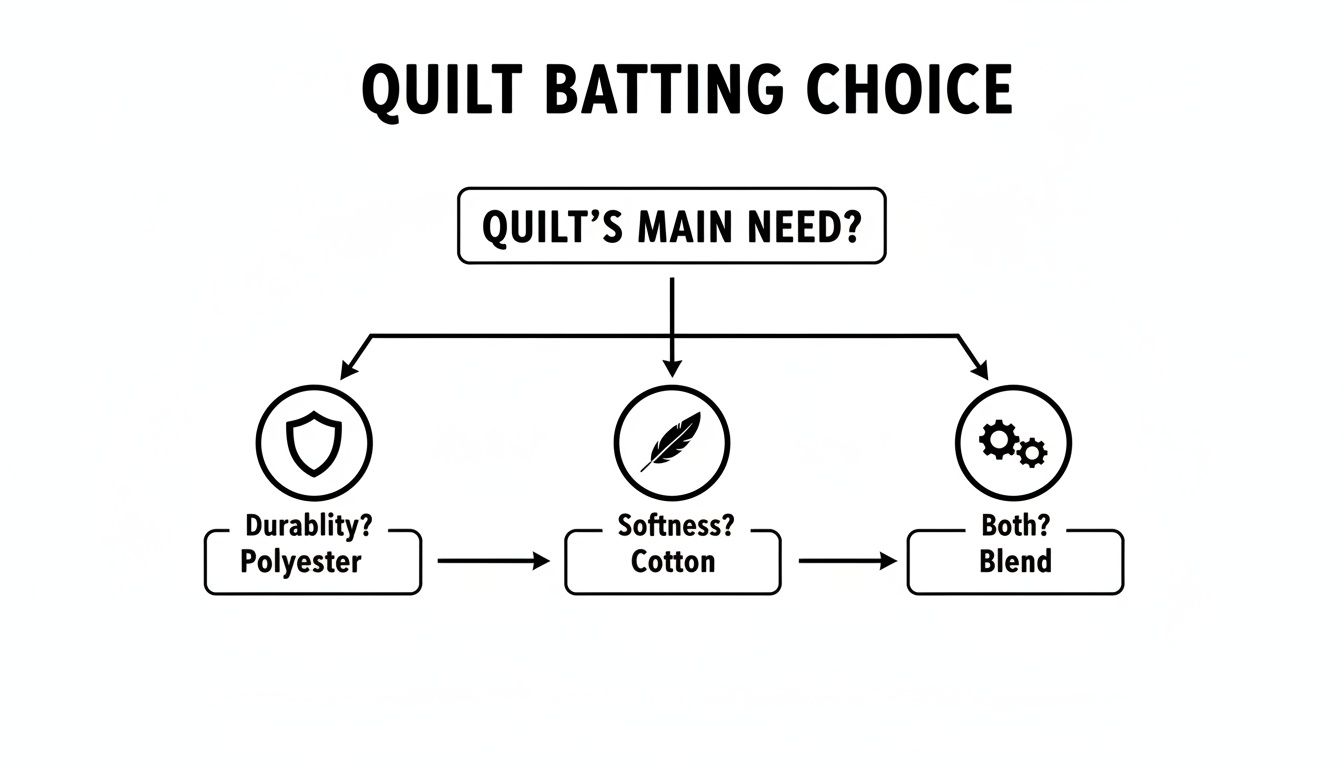
As you can see, when your number one priority is a quilt that will last forever, polyester is the clear winner.
Consider Specialty Polyester Options
Beyond the standard fluffy white stuff, the world of polyester has some pretty clever tricks up its sleeve. These specialty battings are designed to solve those annoying little problems that can keep a good quilt from being truly great.
One of the most useful is black polyester batting. If you've ever quilted with dark, saturated fabrics, you've probably seen it: "bearding." Those tiny white fibers from the batting sneak their way through the needle holes and dot your beautiful navy or black fabric. It's frustrating!
Using black batting under dark fabrics is a professional-level technique that ensures a flawless finish. It completely eliminates the risk of white fiber migration, keeping your rich blues, deep purples, and true blacks looking crisp and clean.
This simple swap is a secret weapon that experienced quilters swear by. It makes an incredible difference in the final look, especially on quilts with high-contrast piecing or intricate quilting. Knowing this little trick means you can walk into any quilt shop with the confidence that you're choosing exactly the right materials for a stunning, professional-quality quilt.
Tips for Quilting With Polyester Batting
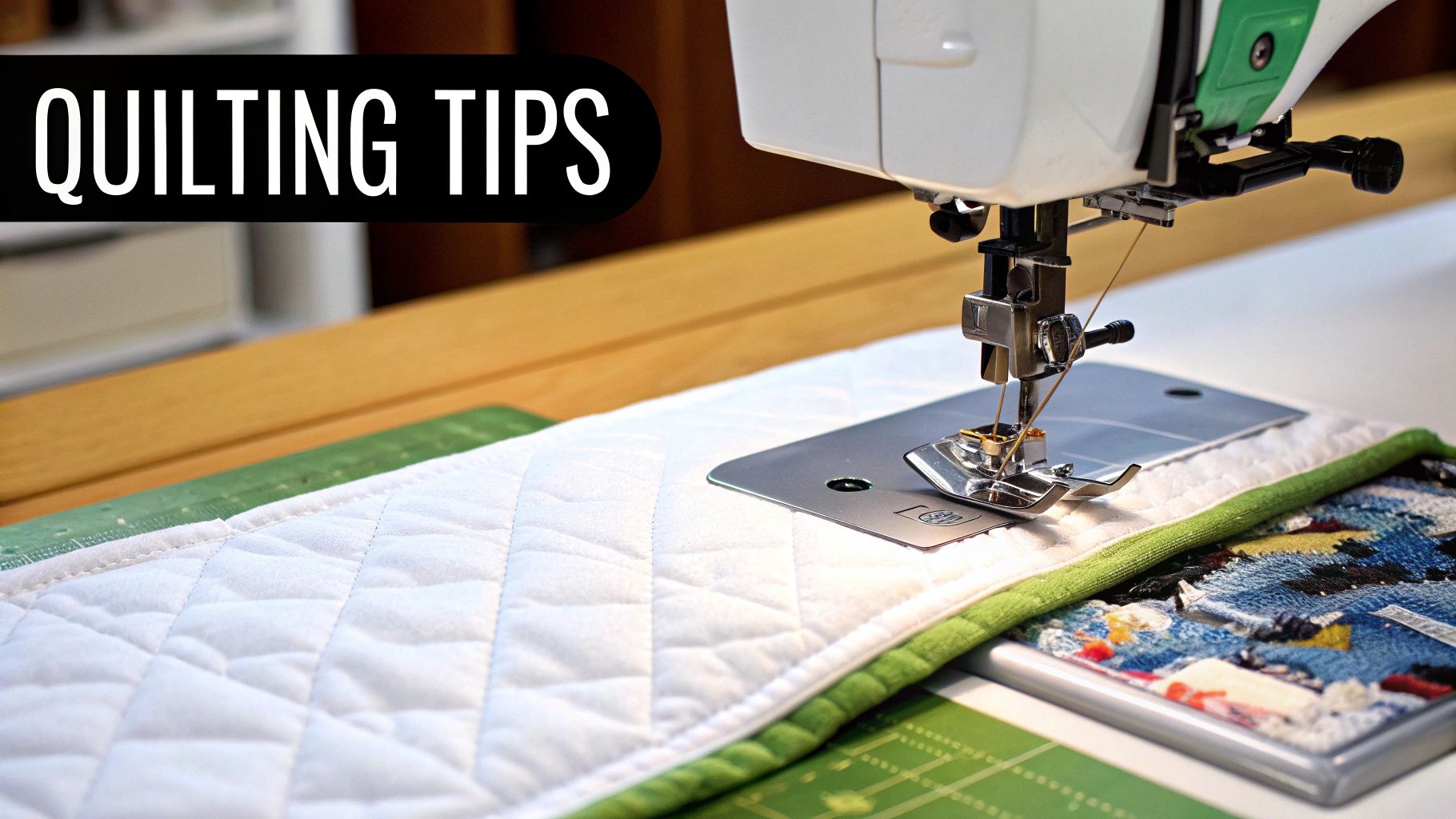
Working with quilt batting polyester is a breeze once you know its quirks. It’s got a wonderfully consistent feel and is forgiving to work with, but a few small tweaks to your setup can take your finished quilt from good to absolutely perfect.
Many quilters make the mistake of treating polyester just like cotton, but they're two different animals. Polyester fibers are a bit slicker, so they play best with certain needles and stitch lengths to avoid puckers and those annoying skipped stitches.
Machine Quilting Best Practices
To get that beautifully smooth finish, let’s start with your machine's needle. A fresh, sharp needle is always a must, but for polyester, a size 90/14 is usually the magic number. It's sturdy enough to punch through all three layers without a struggle, but it won't leave gaping holes behind.
Next up, take a look at your stitch length. I find that lengthening it just a bit, somewhere in the 3.0 to 3.5 mm range, works wonders. This gives the lofty fibers some breathing room between each stitch, which really helps your quilting pattern pop and keeps the fabric from looking squashed.
Finally, make sure your quilt sandwich is stable before you start. Good basting is everything when it comes to preventing shifting and puckering. If you want a refresher, we have a great guide on how to baste a quilt effectively that will set you up for success.
Pro Tip: Ever seen those tiny white fibers poking through your quilt top? That's called "bearding," and a dull needle is almost always the culprit. The moment you spot it, swap out for a new needle. A fresh one will pierce the fabric cleanly instead of dragging fibers through with it.
Care and Storage Made Simple
One of the best things about working with polyester is how incredibly low-maintenance it is. If you're looking for a batting that fits a busy life, this is it. No fussy washing rules here!
Here’s how to keep your polyester quilts looking fantastic for years:
- No Pre-Washing Needed: Seriously, you can skip this step entirely. Polyester has almost zero shrinkage, so you can pull it out of the package and get right to quilting.
- Machine Wash and Dry: Go ahead and toss it in the machine! Wash on a gentle cycle with cool or warm water, then tumble dry on a low-heat setting. You’ll be amazed at how fast it dries compared to natural fibers.
- Proper Storage: The key to preserving that beautiful loft is to roll, don't fold. Folding creates stubborn creases that are a real pain to get out. Just roll it up and pop it in a breathable bag to keep it dust-free and ready for your next project.
Got a Few More Questions About Polyester Batting?
Even after digging into all the details, you might have a couple of questions still rattling around in your head. That's perfectly okay! Let's clear up some of the most common things quilters ask, so you can head into your next project feeling totally sure of your choices.
Think of this as our final chat over the cutting table. We'll talk about things like breathability, the environmental side of things, and whether polyester is really the best fit for every quilt. By the end, you'll have a complete picture.
Is Polyester Batting Really Breathable?
This question comes up all the time, usually because of old-school ideas about polyester. It's true that polyester doesn't "breathe" in the exact same way cotton or wool does, but modern manufacturing has completely changed the game.
Today's polyester batting is made with incredibly fine, lofty fibers. These fibers are designed to trap air, which is what gives you amazing insulation without that heavy, stuffy feeling. It delivers a lot of warmth for its weight, making it a fantastic pick for cozy bed quilts that won't leave you feeling smothered. That said, if you're making a light-as-air summer quilt, a natural fiber might feel a touch cooler.
Can I Iron Directly on Polyester Batting?
Short answer: please don't! It's always best to keep a hot iron far away from direct contact with polyester batting. Those synthetic fibers can melt under high heat, which will wreck your batting and could leave a gummy mess on your iron.
If you absolutely must press out some stubborn wrinkles from being folded, always use a pressing cloth as a buffer. Just place a piece of cotton fabric over the batting and use a low to medium heat setting to be extra safe.
Honestly, the best trick for getting wrinkles out of polyester batting is to just toss it in your dryer. Pop it on a low-heat or air-fluff cycle for 10–15 minutes, and it will come out smooth and relaxed, no melting risk involved.
Is Polyester Batting an Eco-Friendly Choice?
The conversation about synthetic fibers and the environment is a big one, but the quilting world is making some really positive strides. Many of the best brands now offer polyester batting made from recycled materials—yep, often from plastic bottles. This brilliant process keeps tons of waste out of landfills and cuts down on the need for new petroleum.
When you see a quilt batting polyester made from recycled content, you're looking at a much more sustainable option that still gives you all the durability and performance you need. Just check the packaging for the details on recycled content. It's an easy way to make a more earth-friendly choice for your craft.
Ready to feel the difference that a high-quality, lofty polyester batting can make? Come explore the full collection of premium options at Quilt Batting. We've got all the top brands you trust, like Hobbs and Pellon, just waiting for your next masterpiece. Find your perfect batting at Quilt Batting today!.